The creature known as the spider monkey evokes a remarkable blend of agility, odd-limbed elegance and canopy mastery. With its long gangly limbs, hook-like fingers and a tail so prehensile it acts almost like a fifth limb, the spider monkey moves through the treetops with a grace that seems almost designed for the skies. But behind the dramatic silhouette lies a complex social animal with deep ecological importance and mounting conservation challenges. This article explores the world of the spider monkey in depth — its anatomy and movement, behaviour and social life, diet and habitat, and finally the threats it faces and what we can do to help.
Anatomy and movement: built for the canopy
One glance at the spider monkey and you immediately notice its unusually long arms and legs compared with its body, and of course that tail. In fact, the tail of the spider monkey is longer than its body in many species, allowing it to curl, grasp, swing and hang — essentially acting as a fifth limb. Their hands are interesting too: unlike many other primates, spider monkeys often have extremely reduced thumbs, or none at all, which helps minimize interference when swinging through trees.
This body-plan is no accident. The spider monkey’s super-long limbs, flexible joints and strong prehensile tail give it the ability to “brachiate” — that is, to swing from handhold to handhold, or branch to branch, often at great speed and height. When moving through the forest canopy, the spider monkey rarely descends to the ground; instead it leaps or drops from high branches, spreads its limbs and tail, and catches the next support with precision.
The tail deserves special praise: at its tip there is often a patch of bare, tough skin, much like a palm, that gives grip and stability. In effect, the spider monkey’s tail can hold its full weight, allowing its hands to free up for climbing, gathering food or grooming. All of these adaptations make the spider monkey one of the most skillful arboreal primates in its range.
Social life and behaviour: canopy communities
While the spider monkey’s physical form is fascinating, its social life is equally intricate. These primates live in what are often called “fission-fusion” societies: a larger community may number up to dozens of individuals, but during the day they split into smaller foraging groups to move and feed more efficiently. Within a large troop, the spider monkey will communicate, groom, play and maintain bonds; but when food is being exploited, smaller units are more nimble and reduce competition.
Communication among spider monkeys is rich. They bark, whine, grunt, and use body language: for instance, in some cases they will break branches above an intruder and drop them, and they may bark or cry out when separated. This is practical: high in the canopy, visibility is limited and sound serves as an important social glue.
When a young spider monkey is born (typically a single infant after a gestation period of about seven months), it clings to its mother’s belly or back for a long time, learning the forest ropes and staying safe until it is weaned over a year or more.es the ground and spends most of its life among the trees, has evolved social strategies to exploit canopy resources and navigate large home ranges. Males often patrol boundaries or explore farther, while females may focus more on feeding and resting. Overall, the social complexity of the spider monkey complements its physical prowess.
Diet, habitat and ecological role: seed-spreader of the forest
The spider monkey primarily inhabits tropical rainforests, from southern Mexico through Central America and into large parts of South America. It thrives in the upper canopy, preferring mature forest with plenty of large fruit-bearing trees. Because it is so adapted to life high above the ground, when forests are disturbed or fragmented, the spider monkey suffers a lot.
When it comes to diet, fruit forms the lion’s share. In many cases, up to 70-90 % of the spider monkey’s diet can consist of fruit, especially ripe, sugary fruits that give quick energy for their active lifestyle. They also eat nuts, seeds, leaves, flowers and occasionally insects or bird eggs when fruit is scarce.
Because they travel across large trees, picking fruit and swallowing seeds which are later excreted elsewhere, spider monkeys play a vital ecological role as seed-dispersers. One estimate suggests that in tropical forests, animals like spider monkeys are responsible for 50-90 % of seed dispersal of large trees. By carrying seeds away from the parent tree and depositing them in new locations, they help maintain the forest’s diversity and regeneration. Thus, this species is more than just a forest dweller — it is a key contributor to forest health.
Conservation status and threats: urgent challenges
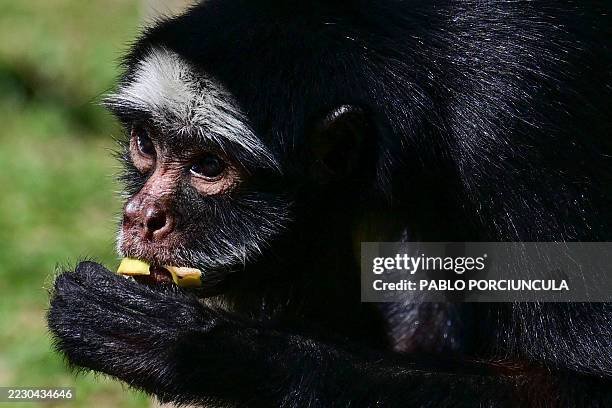
Despite their elegance and ecological importance, spider monkeys face serious threats. According to assessments by International Union for Conservation of Nature (IUCN) and wildlife-conservation groups, all true spider monkey species are in decline. Many are listed as Vulnerable, Endangered or even Critically Endangered.
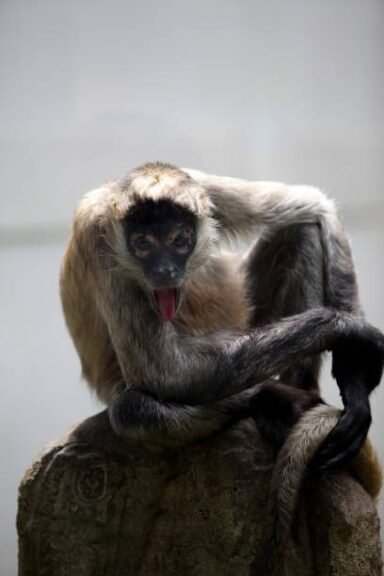
The two most significant threats are habitat destruction and hunting/trade. Large swathes of tropical forest are being cleared for logging, agriculture, cattle ranching and road construction. Because spider monkeys depend on tall trees in the canopy, they are especially vulnerable when the forest is fragmented or degraded. At the same time, they are hunted for food in some regions and illegally captured for the exotic pet trade, further reducing wild populations.
What makes things worse is that when forest patches become small and isolated, spider monkey social groups may lose access to necessary fruiting trees and may even be forced to descend to the ground, where they are more vulnerable to predation or hunting. Some species’ home ranges are shrinking, and populations are fragmented into pockets that may not be viable over time. Conservationists are increasingly calling for protected corridors, improved forest management, anti-hunting enforcement and local community engagement.
For many of us, the spider monkey is a symbol of forest health. Its struggle reminds us that preserving trees is not just about wood or land-use — it is about preserving the intricate networks of life in the canopy, which sustain creatures just as much as they sustain trees.
What we can do and why it matters
Given all of the above, it’s natural to ask: what can we do? First, supporting forest protection initiatives is critical. When mature forests are maintained, the spider monkey and many other species benefit. Certification of sustainable forestry, protected area expansion and pressure on deforestation all help. Groups such as the World Wildlife Fund (WWF) are engaged in exactly these kinds of efforts.
Second, reducing demand for illegal wildlife trade — and raising awareness that wild primates do not make good pets — is vital. The spider monkey’s welfare is compromised when removed from its social and ecological context; captive situations often lead to malnutrition, behavioural problems and early death. Third, supporting research and monitoring of spider monkey populations helps conservationists understand how best to allocate resources and design corridors that allow gene flow between fragmented groups.
Finally, from a broader perspective, the spider monkey’s plight connects to the bigger picture of tropical forest conservation and climate resilience. Healthy forests sequester carbon, regulate rainfall and harbour biodiversity. Saving species like the spider monkey is one piece of a global puzzle for sustainable ecosystems.
Conclusion
The spider monkey is a masterpiece of evolutionary engineering — limbs crafted for swinging, a tail turned into a fifth hand, a social life high in the canopy, and an ecological role that extends far beyond its silhouette. Yet despite all its strengths, it is vulnerable, caught in the cross-fire of habitat destruction, hunting and fragmentation. Realising that the spider monkey is more than a curious creature — that it is a sentinel for forest health — may be our most important takeaway. By valuing the spider monkey and the forest it inhabits, we are recognising a web of life that supports both that creature and, ultimately, ourselves.